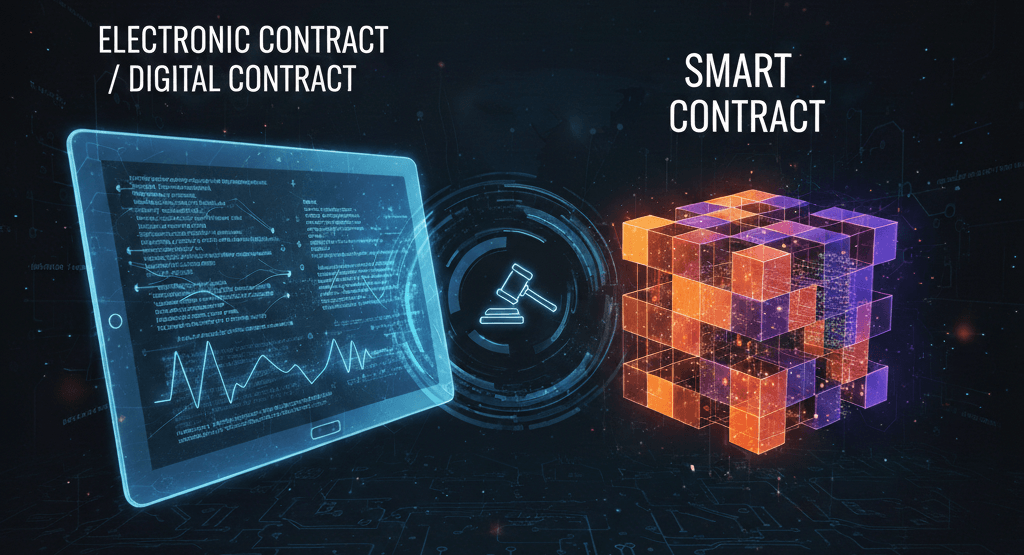
1. Digital (electronic) contract
An electronic/digital contract is digital content, originating and delivered in electronic form, created in the form of an electronic document, which implies content material stored in electronic form, whether it is text, sound, pictorial (visual) or sound-pictorial (audiovisual) recording, information, or a set of data. It is concluded using electronic means, and the general rules of contract formation are used for its formation.
The main characteristics of an electronic/digital contract are:
Form: It is created in the form of an electronic document, which implies electronically stored text, sound, visual/audiovisual recording, information, or a set of data.
Means of conclusion: It is concluded using electronic means and is based on the general rules of contract formation.
Subject: It can be both an electronic service/product, as well as any other service that involves an obligatory relationship between a trader and a consumer. At the same time, the digital contract itself also represents a digital product and service.
Remote character: A remotely concluded contract, where the parties are not physically present simultaneously, is an electronic contract.
Unlike a remote contract, for the existence of a digital contract, the form of concluding the contract is important and not the form of agreeing on the terms. Specifically, according to subparagraph "d" of Article 4 of the Law of Georgia "On the Protection of Consumer Rights", a contract is not considered a remote contract if the consumer and the trader agreed on the terms of the contract at the business premises and the contract was concluded remotely only after this.
2. Smart Contract
A smart contract is a new type of agreement in which the terms of the transaction, presented in digital form, are computer code. A smart contract, a bilateral contract concluded between businesses, between individuals, and between machines, is executed automatically. A smart contract may contain operational and non-operational conditions (clauses). Conditional logic is built into the mentioned clauses, according to which actions are carried out at a specific time and with a specific event, whether it is depositing a specific amount for a payment date in a financial organization at a defined floating interest rate or other financial operations. Non-operational clauses do not have conditional logic, but are connected to the broad legal relationship existing between the parties: which law should be applied, which court should have jurisdiction, etc.
Essence: This is self-executing software code in which the terms of the transaction are presented in digital form (in computer code). According to Nick Szabo's definition, this is a "set of promises" that includes protocols to execute these promises.
Automation: It is characterized by the automatic execution of obligations upon the occurrence of predefined conditions (conditional logic), without additional actions by the parties.
Technological basis: It functions on the basis of distributed ledger technologies (DLT) (e.g., blockchain), which ensures its security and immutability.
Structure: It may contain operational clauses (logic built into the code for specific actions) and non-operational clauses (legal framework, e.g., which law is applied).
3. Mutual Intersection
The digital contract and the smart contract intersect in the following aspects:
Categorical relationship: A smart contract is considered a subtype of an electronic contract. It is similar to a traditional agreement, but in a fully digitized form.
Legal nature: A smart contract, just like other digital contracts, fits into the definition of an electronic document. In order for a smart contract to be legally binding, it must satisfy the general requirements for the validity and formation of a contract (the will of the parties, adequate terms), which software code alone cannot replace.
Functional intersection: In the process of concluding and executing a digital contract, a smart contract can be used as a technological tool (for example, a payment tool for regular transfers. It is possible).