LegalGELegalGE
ServicesSpecialistsTrainingsNewsContact
...
Loading...
LEGAL.GELEGAL.GE

Legal Services Platform

Quick Links

  • Services
  • Specialists
  • Companies
  • Blog
  • Contact

Legal

  • Privacy Policy
  • Terms & Conditions
  • Cookie Policy

Contact

contact@legal.ge

+995 551 911 961

Tbilisi, Georgia

© 2026 LEGAL.GE — All rights reserved.

Made with in Georgia

უკან ბლოგზე
Legaltech

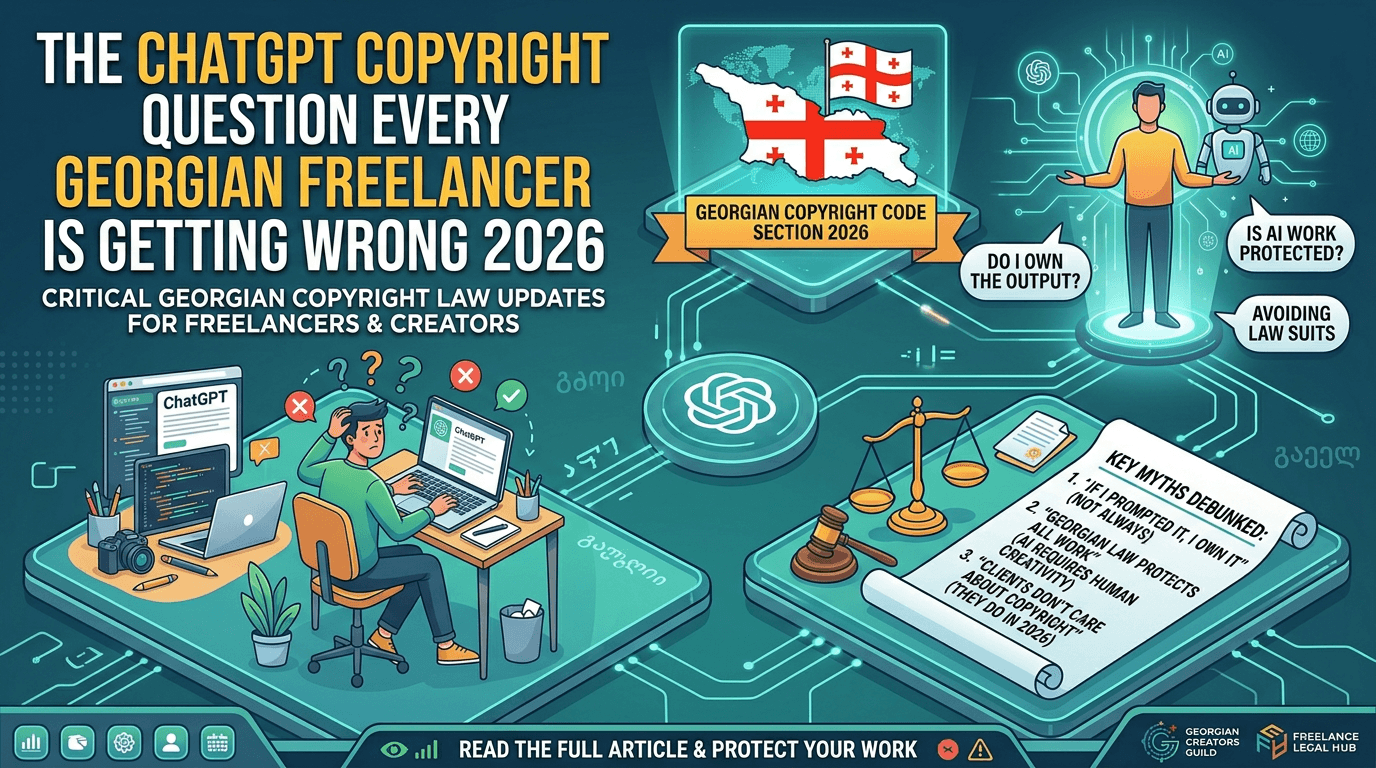
The ChatGPT Copyright Question Every Georgian Freelancer Is Getting Wrong 2026

1. Can AI like ChatGPT be considered the author of a work under Georgian law?

No, according to Georgia's Law on Copyright and Related Rights, copyright belongs only to a natural person (human) whose intellectual-creative activity created the work. AI systems cannot be authors, so AI-generated content lacks automatic copyright protection afforded to human works.

2. Who owns the output generated by ChatGPT, and can I use it commercially?

Per OpenAI's Terms of Use, the generated output belongs to the user (with reservations, like OpenAI's right to use inputs for model improvement). Commercial use is allowed if you comply with platform rules, but legal risks like plagiarism or lack of originality may still apply.

3. What are the key legal risks when using AI-generated content?

Main risks include lack of originality leading to plagiarism or copyright infringement (if based on protected works), potential authorship disputes from clients, and evolving international practices (e.g., US Copyright Office requires significant human contribution for protection). Each work needs individual analysis.
3 წუთი
The ChatGPT Copyright Question Every Georgian Freelancer Is Getting Wrong 2026

Who Owns a Work Written by ChatGPT? A Legal Analysis

Thousands of Georgian freelancers, copywriters, bloggers, and startups currently utilize ChatGPT to create content. The question that everyone asks, but few answer, is this: if the AI wrote it, is it mine? Can I use this work? And/or can I attribute it to myself

Answering this question is not simple, as the answer depends on several factors.

The Law of Georgia on “Copyright and Related Rights” unequivocally establishes that copyright belongs to the creator of the work-the natural person through whose intellectual-creative activity the work was created. Consequently, artificial intelligence, as a system, cannot be considered an “author” within the context of Georgian law.

This means that, for example, text generated through ChatGPT does not automatically possess the legal protection afforded to a work created by a human. Even if we allow for a hypothesis regarding artificial intelligence authorship, the question arises: how would the system be able to enjoy the rights that copyright law guarantees to an author? Copyrights are not merely a prerequisite for recognition; their purpose is for the author to receive economic benefit and material income from their own creation. Artificial intelligence possesses no such needs; therefore, satisfying these rights is physically impossible.

OpenAI’s Terms of Use determine that the generated Output - that is, the content created by the artificial intelligence - belongs to the user, subject to certain reservations. Specifically:

·         The user provides the initial data (Input/Prompt) to the system;

·         OpenAI reserves the right to use this data for the further improvement of the model;

·         Commercial use is permitted within the framework of complying with the platform's rules.

Accordingly, a ChatGPT Plus or API user is formally authorized to realize here implies the commercial exploitation or sale the generated text. However, the legal side of the issue is not exhausted by this alone.

Core Legal Risks

The real problem, first and foremost, relates to the lack of originality of the work:

·         If the artificial intelligence created the text based on the protected works of other authors, there is a risk of plagiarism or copyright infringement

·         International judicial practice is developing rapidly, as evidenced by the ongoing dispute between such giants as Getty Images and OpenAI;

·         The client, in whose name the text is published, may raise a claim regarding authorship, which creates additional legal disputes;

·         According to the updated guidance from the United States Copyright Office, the core part of the creative process must still be carried out by a human. Artificial intelligence may be considered only as an auxiliary tool, provided that the work does not lose its originality and clearly reflects the human intellectual contribution.

Consequently, every work created by or with the participation of artificial intelligence requires individual evaluation and analysis, as it is impossible to provide a preliminary, universal answer to this issue. It can only be stated unequivocally that only a natural person should be considered an author. Meanwhile, whether a user will be considered the author of a work created through artificial intelligence depends on several factors: in what dosage and form the technology was used, to what extent it is possible to separate human intellectual effort from machine labor, and the degree to which the creative process remains directed by the human.

Need Professional Help?

If you need qualified specialist consultation or services on this topic, you can:

Find a Specialist
Find the right expert for you
Or contact us:
Email
contact@legal.ge
Phone
+995 551 911 961
WhatsAppViber

მსგავსი სტატიები

The Nature and Intersection of Digital and Smart Contracts

The Nature and Intersection of Digital and Smart Contracts

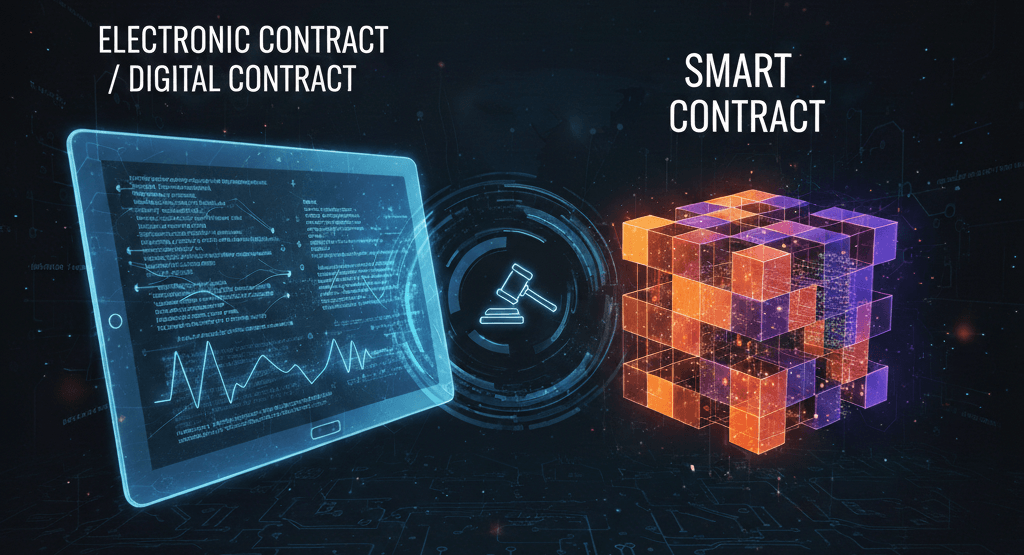
Digital contracts and smart contracts intersect across the following dimensions: Taxonomic Classification: A smart contract is categorized as a subset of an electronic contract. It functions similarly to a traditional agreement, though executed in a comprehensively digitized format. Legal Nature: Smart contracts, analogous to other digital contracts, are encompassed within the legal definition of an electronic document. For a smart contract to constitute a legally binding agreement, it must fulfill the fundamental prerequisites of contract formation and validity (e.g., mutual consent of the parties and adequate terms)—requirements that programming code alone cannot substitute. Functional Overlap: Within the processes of concluding and executing a digital contract, a smart contract may be implemented as a technological utility (for example, as an automated payment mechanism for recurring transactions).
Can Artificial Intelligence Be an Author?

Can Artificial Intelligence Be an Author?

The involvement of Artificial Intelligence (AI) can transcend the outcomes predetermined by a user; consequently, AI itself could be perceived as an author, given that modern AI possesses the capability to create works without human intervention. This theory is quite provocative, as it directly contradicts the standard definition of authorship, according to which an author is a natural person through whose intellectual-creative activity a work is produced. It is important to note that the primary-and perhaps only-advantage of machine authorship is that it aligns with the core logic of intellectual property rights, which dictates that the creator is the author.
New Concepts of Digital Law: Big Data, BDCE, and FinTech

New Concepts of Digital Law: Big Data, BDCE, and FinTech

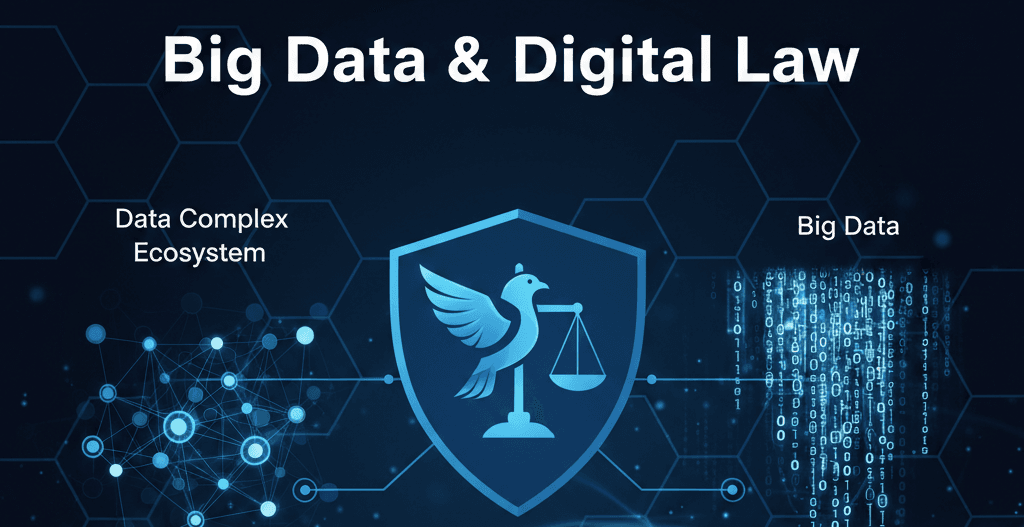
The legal regulation of the digital economy requires understanding the technological foundations driving the financial and business sectors. This analysis identifies four essential pillars for legal professionals: Big Data: Substantial volumes of heterogeneous digital data, facts, and unrestricted activities collected at high velocity. It is characterized by real-time processing through advanced analytical algorithms. Big Data Complex Ecosystem (BDCE): An IT infrastructure consisting of integrated systems for data collection, storage, and use. It unites data owners, cloud providers, and academic institutions into a unified infrastructure. Data Architecture: A component of the BDCE that defines how data is processed, stored, and integrated for organizational purposes. It serves as a conceptual model for data governance, lifecycle management, and security. FinTech and Big Personal Data: Financial Technology leverages Big Data, AI, and Distributed Ledger Technologies (DLT) for platform-based service delivery. This process generates "Big Personal Data"—personal information created or processed within these complex ecosystems.
The Intersection of Big Data and Market Competition in Georgia

The Intersection of Big Data and Market Competition in Georgia

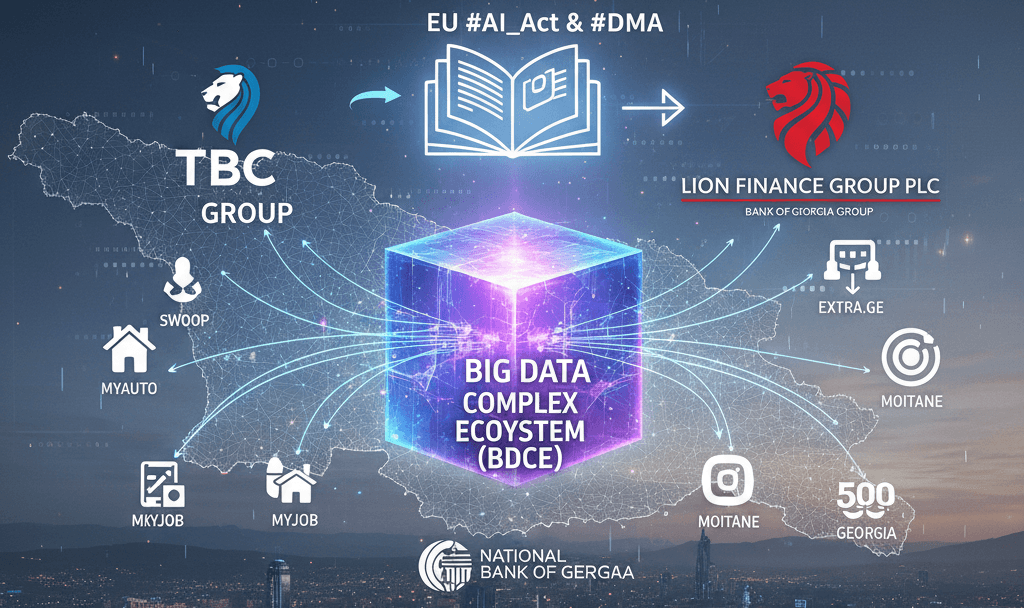
In today's fast-moving digital economy, the lines between where we bank and where we shop, work, and live are becoming increasingly blurred. In Georgia, this evolution has reached a critical tipping point as the nation's two largest financial giants—TBC Group and Lion Finance Group PLC (formerly Bank of Georgia Group)—have successfully built sprawling "digital ecosystems" that touch almost every aspect of a citizen's daily life. From buying a car on MyAuto to managing a small business with Optimo, these platforms are no longer just apps; they have become the "gatekeepers" of the Georgian digital marketplace. While this integration offers undeniable convenience, it raises a profound structural question for our market: What happens when the people who hold our money also hold all of our data?