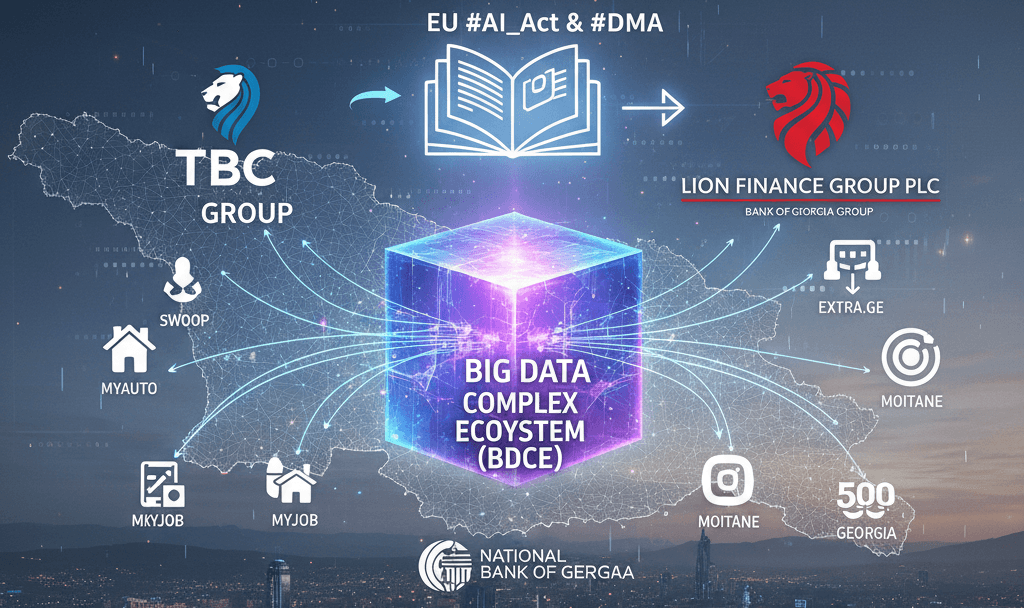
The ChatGPT Copyright Question Every Georgian Freelancer Is Getting Wrong 2026
1. Can AI like ChatGPT be considered the author of a work under Georgian law?
No, according to Georgia's Law on Copyright and Related Rights, copyright belongs only to a natural person (human) whose intellectual-creative activity created the work. AI systems cannot be authors, so AI-generated content lacks automatic copyright protection afforded to human works.
2. Who owns the output generated by ChatGPT, and can I use it commercially?
Per OpenAI's Terms of Use, the generated output belongs to the user (with reservations, like OpenAI's right to use inputs for model improvement). Commercial use is allowed if you comply with platform rules, but legal risks like plagiarism or lack of originality may still apply.
3. What are the key legal risks when using AI-generated content?
Main risks include lack of originality leading to plagiarism or copyright infringement (if based on protected works), potential authorship disputes from clients, and evolving international practices (e.g., US Copyright Office requires significant human contribution for protection). Each work needs individual analysis.
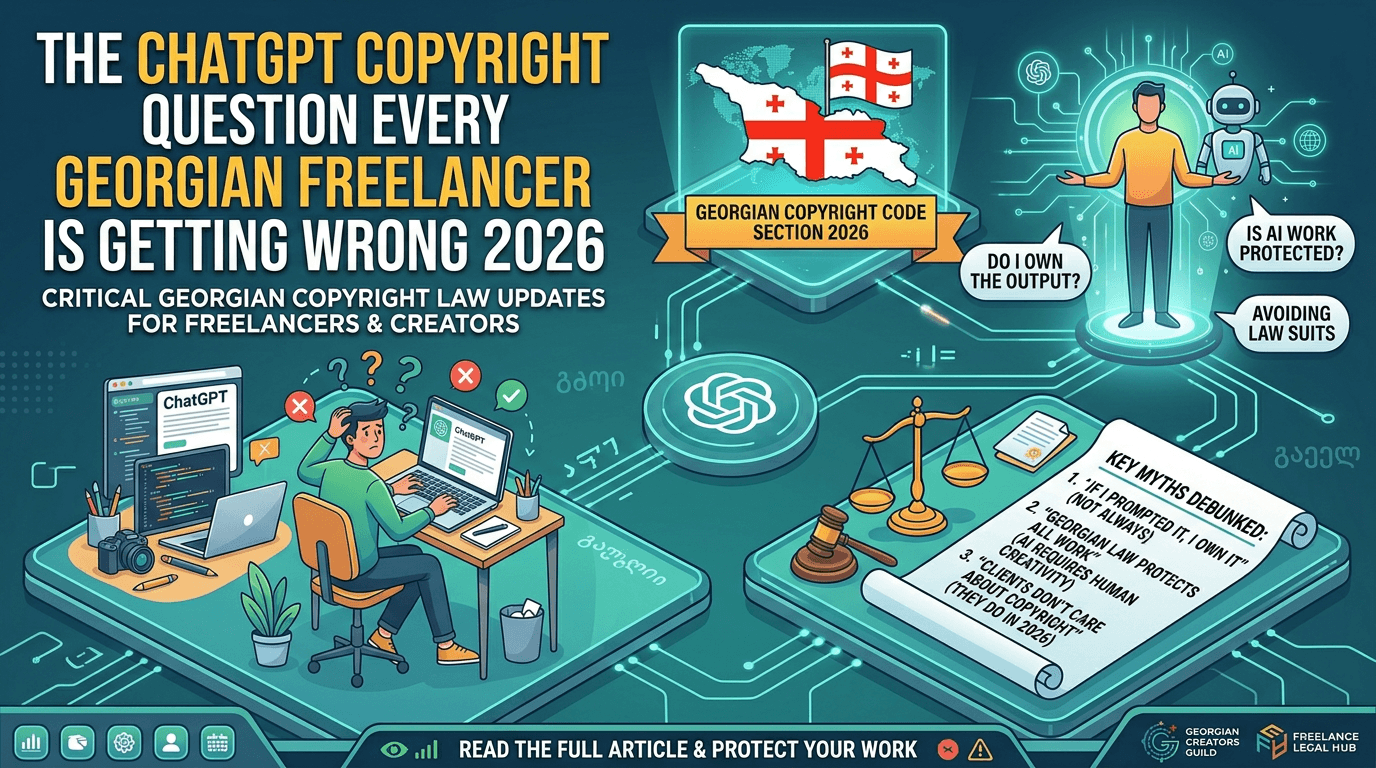
Who Owns a Work Written by ChatGPT? A Legal Analysis
Thousands of Georgian freelancers, copywriters, bloggers, and startups currently utilize ChatGPT to create content. The question that everyone asks, but few answer, is this: if the AI wrote it, is it mine? Can I use this work? And/or can I attribute it to myself
Answering this question is not simple, as the answer depends on several factors.
The Law of Georgia on “Copyright and Related Rights” unequivocally establishes that copyright belongs to the creator of the work-the natural person through whose intellectual-creative activity the work was created. Consequently, artificial intelligence, as a system, cannot be considered an “author” within the context of Georgian law.
This means that, for example, text generated through ChatGPT does not automatically possess the legal protection afforded to a work created by a human. Even if we allow for a hypothesis regarding artificial intelligence authorship, the question arises: how would the system be able to enjoy the rights that copyright law guarantees to an author? Copyrights are not merely a prerequisite for recognition; their purpose is for the author to receive economic benefit and material income from their own creation. Artificial intelligence possesses no such needs; therefore, satisfying these rights is physically impossible.
OpenAI’s Terms of Use determine that the generated Output - that is, the content created by the artificial intelligence - belongs to the user, subject to certain reservations. Specifically:
· The user provides the initial data (Input/Prompt) to the system;
· OpenAI reserves the right to use this data for the further improvement of the model;
· Commercial use is permitted within the framework of complying with the platform's rules.
Accordingly, a ChatGPT Plus or API user is formally authorized to realize here implies the commercial exploitation or sale the generated text. However, the legal side of the issue is not exhausted by this alone.
Core Legal Risks
The real problem, first and foremost, relates to the lack of originality of the work:
· If the artificial intelligence created the text based on the protected works of other authors, there is a risk of plagiarism or copyright infringement
· International judicial practice is developing rapidly, as evidenced by the ongoing dispute between such giants as Getty Images and OpenAI;
· The client, in whose name the text is published, may raise a claim regarding authorship, which creates additional legal disputes;
· According to the updated guidance from the United States Copyright Office, the core part of the creative process must still be carried out by a human. Artificial intelligence may be considered only as an auxiliary tool, provided that the work does not lose its originality and clearly reflects the human intellectual contribution.
Consequently, every work created by or with the participation of artificial intelligence requires individual evaluation and analysis, as it is impossible to provide a preliminary, universal answer to this issue. It can only be stated unequivocally that only a natural person should be considered an author. Meanwhile, whether a user will be considered the author of a work created through artificial intelligence depends on several factors: in what dosage and form the technology was used, to what extent it is possible to separate human intellectual effort from machine labor, and the degree to which the creative process remains directed by the human.
Not sure if this is the right service?
Tell us your situation — we'll point you in the right direction.
Read more on this topic
Personal Data Protection for Business in Georgia 2026
Personal Data Protection for Business in Georgia: What Companies Should Consider in 2026
Introduction: What Changed on March 2, 2026? As of March 2, 2026, the Personal Data Protection Service was abolished and its functions - supervision, inspections, incident review, and receipt of statements from subjects - were transferred to the State Audit Service. This change raises open questions. The Personal Data Protection Service was a specialized, separately established institution, while the main mandate of the State Audit Service is control of state finances. The specialized competence and speed of the new structure are still to be tested. Business and the civil sector should closely monitor this development. What has not changed: The requirements of the law - obligations, penalties, and rights of subjects - are in full force. Official contact: State Audit Office - sao.ge
Part I: Who does the law apply to?
The Law “On Personal Data Protection” applies to all persons or organizations that process data on the territory of Georgia using automated or semi-automated means; or are based outside Georgia but process local data using technical means available in Georgia. This means that the law applies to: all companies, institutions where personal data of a person is processed. Video, audio monitoring. Exception: completely personal and family activities of a natural person, which are not related to entrepreneurial or professional activities. In addition, the law does not apply to the processing of personal data of a legal entity. The focus of the law is the personal data of a natural person.
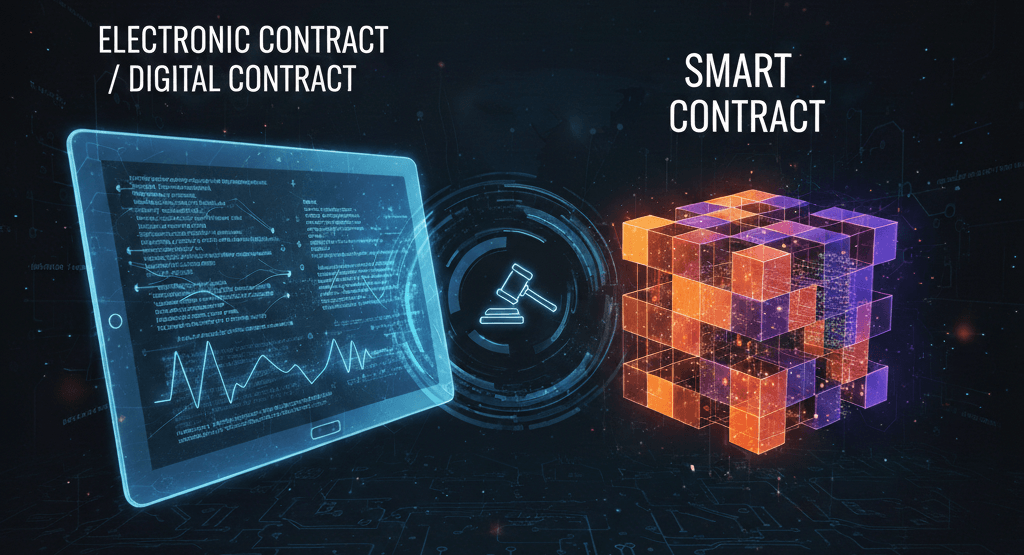
The Nature and Intersection of Digital and Smart Contracts
Can Artificial Intelligence Be an Author?
New Concepts of Digital Law: Big Data, BDCE, and FinTech