LegalGELegalGE
AboutSpecialistsOrganisationsBlogContact
LegalTools
...
Loading account
AboutSpecialistsOrganisationsBlogContact
LegalTools
Loading account
LEGAL.GELEGAL.GE

Georgia’s legal marketplace.

Quick Links

  • About Us
  • Specialists
  • Services
  • Firms
  • Organisations
  • Training
  • Blog
  • Contact

Legal

  • Legal library
  • Privacy Policy
  • Terms & Conditions
  • Cookie Policy

Contact

contact@legal.ge+995 551 911 961

Tbilisi, Georgia

Specialist Directory

Criminal Law AttorneyCriminal Law LawyerCivil Law AttorneyCivil Law LawyerCorporate & Commercial Law AttorneyCorporate & Commercial Law LawyerLabor & Employment Law AttorneyLabor & Employment Law LawyerTax Law AttorneyTax Law LawyerDispute Resolution & Litigation AttorneyDispute Resolution & Litigation Lawyer

© 2026 Legal.ge. All rights reserved.

Made with in Georgia

  1. Blog
  2. Justice
  3. Family law
  4. Divorce in Georgia: Procedure, Deadlines, and th…
Read in:ქართული|Русский
Family law

Divorce in Georgia: Procedure, Deadlines, and the Role of a Lawyer

Divorce can be done through a notary (by mutual agreement) or through a court. The article explains the procedure, the required documents and deadlines, the rules for dividing alimony and joint property, child custody, and when a lawyer is necessary.
3 min·Legal.ge news
Divorce in Georgia: Procedure, Deadlines, and the Role of a Lawyer

Divorce in Georgia: Procedure, Deadlines, and the Role of a Lawyer

When can a divorce be easily finalized, when does it require a court order — and what you need to know about alimony, property division, and custody.

Divorce is an emotionally difficult process, but legally in Georgia it is often simpler than many people think. It is important to understand the two main paths — administrative (by mutual agreement) and judicial — and when each is used. This article explains in simple language the procedure, timelines, and the issues that are most often the subject of dispute.

Two ways to divorce

If both spouses agree and there is no dispute between them, a divorce can be obtained administratively — by filing an application with the Civil Registry Agency (House of Justice). This is the fastest and least expensive way. If one of the spouses does not agree, or there is a dispute over children, alimony, or property, the case is heard in court .

Required documents

For an administrative divorce, as a rule, the following are required: identity documents of both spouses, a marriage certificate, and a statement of the prescribed form. For a judicial divorce, a lawsuit and evidence on the issues in dispute (e.g., child's place of residence, alimony, division of property) are additionally required.

Alimony

Alimony primarily serves the interests of the child. Its amount is determined by agreement of the parties or by court decision, taking into account the needs of the minor and the parent's capabilities. In certain cases, alimony may also be imposed on the spouse.

Division of common property

Under Georgian law, property acquired during marriage is usually considered joint property (co-owned) between spouses and is divided upon divorce. Property acquired before marriage or received as a gift/inheritance is considered separate property. Property can be divided by agreement of the parties or through a court order.

Child custody and parental rights

Even after divorce, both parents retain parental rights and responsibilities. In the event of a dispute, the court decides on the child's place of residence and the rules of relationship with the other parent, based on the principle of the child's best interests.

When do you need a lawyer?

If the divorce is amicable and there are no disputes, a lawyer is often not necessary. However, when it comes to children, alimony, or significant property, a lawyer can help you protect your rights, prepare documents and negotiate, or represent you in court.

Frequently Asked Questions

How long does a divorce take? Administratively, relatively quickly; judicially, the time frame depends on the complexity of the dispute.

Is it possible to get a divorce without the consent of the other party? Yes, through the court.

The article is for general informational purposes only and does not constitute legal advice. For assistance with your specific case, please contact Legal.ge specialists .
Connect with Specialist

Have questions about this topic? Get professional advice.

Read more on this topic

LLC vs Individual Entrepreneur in Georgia: Which Is Right for Foreigners (2026)

LLC vs Individual Entrepreneur in Georgia: Which Is Right for Foreigners (2026)

Choosing between an LLC and Individual Entrepreneur status is the first big decision for foreigners doing business in Georgia. This guide compares personal liability, the 1% small-business turnover regime versus profit-based taxation, accounting burden, and setup cost and time — and gives a clear rule of thumb for which structure fits which founder.
Personal Data Protection for Business in Georgia 2026

Personal Data Protection for Business in Georgia 2026

Personal Data Protection for Business in Georgia: What Companies Should Consider in 2026

Introduction: What Changed on March 2, 2026? As of March 2, 2026, the Personal Data Protection Service was abolished and its functions - supervision, inspections, incident review, and receipt of statements from subjects - were transferred to the State Audit Service. This change raises open questions. The Personal Data Protection Service was a specialized, separately established institution, while the main mandate of the State Audit Service is control of state finances. The specialized competence and speed of the new structure are still to be tested. Business and the civil sector should closely monitor this development. What has not changed: The requirements of the law - obligations, penalties, and rights of subjects - are in full force. Official contact: State Audit Office - sao.ge

Part I: Who does the law apply to?

The Law “On Personal Data Protection” applies to all persons or organizations that process data on the territory of Georgia using automated or semi-automated means; or are based outside Georgia but process local data using technical means available in Georgia. This means that the law applies to: all companies, institutions where personal data of a person is processed. Video, audio monitoring. Exception: completely personal and family activities of a natural person, which are not related to entrepreneurial or professional activities. In addition, the law does not apply to the processing of personal data of a legal entity. The focus of the law is the personal data of a natural person.

Why are bank accounts being denied in Georgia in 2026, and how can I open one?

Why are bank accounts being denied in Georgia in 2026, and how can I open one?

In 2026, opening an account with a Georgian bank became more difficult: banks aligned their procedures with FATF standards and require confirmation of the source of funds and purpose of the account. This article explains why non-residents are being rejected, what documents to prepare, and how to pass KYC at Bank of Georgia and TBC the first time.
Do banks have the right to block client accounts?

Do banks have the right to block client accounts?

When the client fully cooperates with the bank, fills out the relevant questionnaires in good faith, submits the requested documentation, and additionally expresses his willingness to provide the bank with the necessary information at any time, there is clearly no legal basis for closing the account.
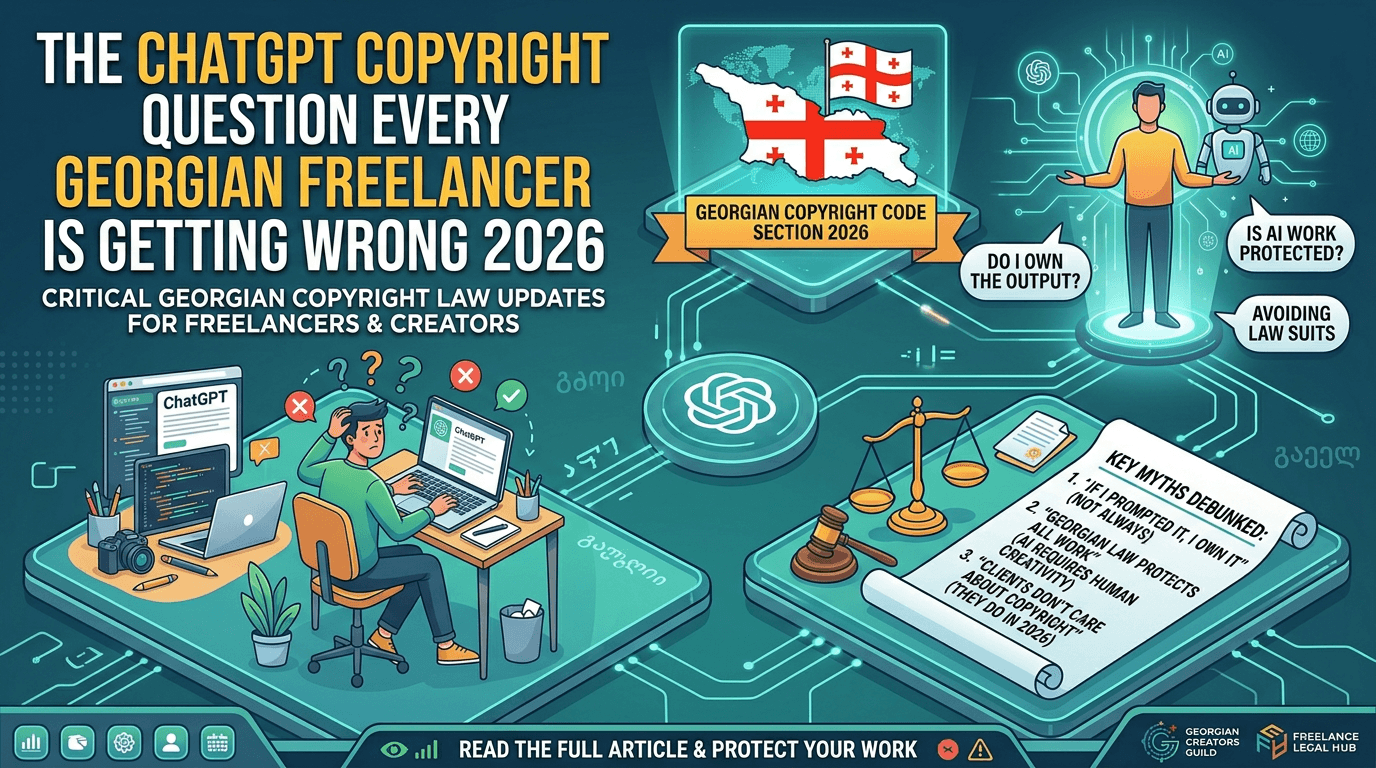
The ChatGPT Copyright Question Every Georgian Freelancer Is Getting Wrong 2026

The ChatGPT Copyright Question Every Georgian Freelancer Is Getting Wrong 2026

1. Can AI like ChatGPT be considered the author of a work under Georgian law?

No, according to Georgia's Law on Copyright and Related Rights, copyright belongs only to a natural person (human) whose intellectual-creative activity created the work. AI systems cannot be authors, so AI-generated content lacks automatic copyright protection afforded to human works.

2. Who owns the output generated by ChatGPT, and can I use it commercially?

Per OpenAI's Terms of Use, the generated output belongs to the user (with reservations, like OpenAI's right to use inputs for model improvement). Commercial use is allowed if you comply with platform rules, but legal risks like plagiarism or lack of originality may still apply.

3. What are the key legal risks when using AI-generated content?

Main risks include lack of originality leading to plagiarism or copyright infringement (if based on protected works), potential authorship disputes from clients, and evolving international practices (e.g., US Copyright Office requires significant human contribution for protection). Each work needs individual analysis.

The Nature and Intersection of Digital and Smart Contracts

The Nature and Intersection of Digital and Smart Contracts

Digital contracts and smart contracts intersect across the following dimensions: Taxonomic Classification: A smart contract is categorized as a subset of an electronic contract. It functions similarly to a traditional agreement, though executed in a comprehensively digitized format. Legal Nature: Smart contracts, analogous to other digital contracts, are encompassed within the legal definition of an electronic document. For a smart contract to constitute a legally binding agreement, it must fulfill the fundamental prerequisites of contract formation and validity (e.g., mutual consent of the parties and adequate terms)—requirements that programming code alone cannot substitute. Functional Overlap: Within the processes of concluding and executing a digital contract, a smart contract may be implemented as a technological utility (for example, as an automated payment mechanism for recurring transactions).