LegalGELegalGE
AboutSpecialistsOrganisationsBlogContact
LegalTools
...
Loading account
AboutSpecialistsOrganisationsBlogContact
LegalTools
Loading account
LEGAL.GELEGAL.GE

Georgia’s legal marketplace.

Quick Links

  • About Us
  • Specialists
  • Services
  • Firms
  • Organisations
  • Training
  • Blog
  • Contact

Legal

  • Legal library
  • Privacy Policy
  • Terms & Conditions
  • Cookie Policy

Contact

contact@legal.ge+995 551 911 961

Tbilisi, Georgia

Specialist Directory

Criminal Law AttorneyCriminal Law LawyerCivil Law AttorneyCivil Law LawyerCorporate & Commercial Law AttorneyCorporate & Commercial Law LawyerLabor & Employment Law AttorneyLabor & Employment Law LawyerTax Law AttorneyTax Law LawyerDispute Resolution & Litigation AttorneyDispute Resolution & Litigation Lawyer

© 2026 Legal.ge. All rights reserved.

Made with in Georgia

  1. Blog
  2. Justice
  3. Business Law
  4. LLC vs Individual Entrepreneur in Georgia: Which…
Read in:Русский|ქართული
Business Law

LLC vs Individual Entrepreneur in Georgia: Which Is Right for Foreigners (2026)

Choosing between an LLC and Individual Entrepreneur status is the first big decision for foreigners doing business in Georgia. This guide compares personal liability, the 1% small-business turnover regime versus profit-based taxation, accounting burden, and setup cost and time — and gives a clear rule of thumb for which structure fits which founder.
5 min·Legal.ge news
LLC vs Individual Entrepreneur in Georgia: Which Is Right for Foreigners (2026)

LLC vs Individual Entrepreneur in Georgia: Which Is Right for Foreigners (2026)

Liability, the 1% turnover regime, profit tax, and setup time — a practical comparison to help foreign founders choose the right structure in Georgia.

Georgia has become one of the easiest countries in the world for foreigners to start a business, but the very first decision — what legal form to use — shapes your taxes, your personal risk, and your paperwork for years. For most foreign founders the choice comes down to two options: registering as an Individual Entrepreneur (IE) or forming a Limited Liability Company (LLC). They are taxed differently, protect you differently, and suit different kinds of business. This guide walks through the trade-offs so you can pick with confidence.

What is an Individual Entrepreneur (IE)?

An Individual Entrepreneur is a registered sole trader — you and the business are legally the same person. Registration is one of the fastest in the world: it is handled at the Public Service Hall (or through a representative by power of attorney) and is usually completed within one business day. The big draw is Small Business Status (SBS), a preferential regime that taxes turnover at just 1% on annual revenue up to 500,000 GEL; revenue above that threshold within the year is taxed at 3%. Crucially, the 1% rate applies to Georgian-sourced income, and certain professional activities (such as legal, medical, audit, and consulting services) are excluded from the regime.

What is an LLC?

An LLC (in Georgian, shps) is a separate legal entity. Its defining feature is limited liability: the company — not you personally — is responsible for its debts and obligations, so your personal assets are generally shielded. An LLC is taxed under Georgia's Estonian-style corporate model, meaning profit tax (15%) is generally due only when profit is distributed to owners, not while it is reinvested in the business. State registration costs 100 GEL for standard processing (one business day) or 200 GEL for expedited service.

Tax: the 1% turnover regime vs. profit tax

This is usually the deciding factor. An IE with Small Business Status pays 1% of turnover — a very low effective rate for a service provider or freelancer with high margins and few costs. An LLC pays 15% on distributed profit. The maths flips depending on your cost structure: a low-cost, high-margin solo business almost always pays less as a 1% IE, while a business with heavy expenses, thin margins, or one that reinvests rather than distributes profit can be better off under the LLC's profit-based model. If your turnover regularly approaches or exceeds 500,000 GEL, the IE advantage narrows and an LLC deserves a closer look.

Liability: the decisive difference

Because an IE is not a separate legal person, the entrepreneur is personally liable for business debts. For a freelancer billing clients for services, that risk is often modest. But the moment you take on inventory, employees, premises, supplier credit, or anything that could generate a claim, the LLC's liability shield becomes valuable. If protecting personal assets matters to you, that alone can justify the LLC even when the IE would save tax.

Cost, setup time, and admin burden

Both structures are quick and cheap to set up by international standards. An IE is essentially free and same-day; an LLC costs 100–200 GEL and is also typically registered within one to three days. Ongoing administration is lighter for an IE on Small Business Status (a simplified monthly turnover declaration), while an LLC has fuller bookkeeping and accounting obligations. Many founders therefore use an accountant for an LLC and self-manage a simple IE.

Which should you choose?

As a rule of thumb: choose the Individual Entrepreneur (1% Small Business Status) if you are a freelancer or solo service provider with Georgian-sourced income, high margins, low costs, and turnover comfortably under 500,000 GEL, and you are comfortable with personal liability. Choose an LLC if you need limited liability, have partners, carry real business risk or significant expenses, plan to reinvest profits, or expect turnover to grow past the small-business threshold. Many founders start as an IE and convert to an LLC as the business scales.

The 2026 work-permit caveat for foreigners

Whichever structure you choose, note an important change: since 1 March 2026 a residence permit or visa no longer automatically grants the right to work or do business in Georgia. Foreign nationals without permanent residency generally need a separate right to engage in labour/entrepreneurial activity, and self-employed foreigners face earlier enforcement deadlines. Factor this into your setup timeline. The specifics are evolving, so confirm your obligations before you register.

FAQ

Can a foreigner own 100% of a Georgian LLC? Yes — there is no local-shareholder requirement, and a non-resident can fully own and manage an LLC.

Does the 1% rate apply to my foreign clients' payments? Small Business Status applies to Georgian-sourced income; how foreign-earned revenue is treated depends on the facts, so seek advice on your specific case.

Can I switch from an IE to an LLC later? Yes. It is common to start lean as an IE and incorporate an LLC once liability, partners, or scale make it worthwhile.

This article is general information, not legal advice. For a recommendation tailored to your situation, book a consultation with Legal.ge.
Connect with Specialist

Have questions about this topic? Get professional advice.

Read more on this topic

Personal Data Protection for Business in Georgia 2026

Personal Data Protection for Business in Georgia 2026

Personal Data Protection for Business in Georgia: What Companies Should Consider in 2026

Introduction: What Changed on March 2, 2026? As of March 2, 2026, the Personal Data Protection Service was abolished and its functions - supervision, inspections, incident review, and receipt of statements from subjects - were transferred to the State Audit Service. This change raises open questions. The Personal Data Protection Service was a specialized, separately established institution, while the main mandate of the State Audit Service is control of state finances. The specialized competence and speed of the new structure are still to be tested. Business and the civil sector should closely monitor this development. What has not changed: The requirements of the law - obligations, penalties, and rights of subjects - are in full force. Official contact: State Audit Office - sao.ge

Part I: Who does the law apply to?

The Law “On Personal Data Protection” applies to all persons or organizations that process data on the territory of Georgia using automated or semi-automated means; or are based outside Georgia but process local data using technical means available in Georgia. This means that the law applies to: all companies, institutions where personal data of a person is processed. Video, audio monitoring. Exception: completely personal and family activities of a natural person, which are not related to entrepreneurial or professional activities. In addition, the law does not apply to the processing of personal data of a legal entity. The focus of the law is the personal data of a natural person.

Divorce in Georgia: Procedure, Deadlines, and the Role of a Lawyer

Divorce in Georgia: Procedure, Deadlines, and the Role of a Lawyer

Divorce can be done through a notary (by mutual agreement) or through a court. The article explains the procedure, the required documents and deadlines, the rules for dividing alimony and joint property, child custody, and when a lawyer is necessary.
Why are bank accounts being denied in Georgia in 2026, and how can I open one?

Why are bank accounts being denied in Georgia in 2026, and how can I open one?

In 2026, opening an account with a Georgian bank became more difficult: banks aligned their procedures with FATF standards and require confirmation of the source of funds and purpose of the account. This article explains why non-residents are being rejected, what documents to prepare, and how to pass KYC at Bank of Georgia and TBC the first time.
Do banks have the right to block client accounts?

Do banks have the right to block client accounts?

When the client fully cooperates with the bank, fills out the relevant questionnaires in good faith, submits the requested documentation, and additionally expresses his willingness to provide the bank with the necessary information at any time, there is clearly no legal basis for closing the account.
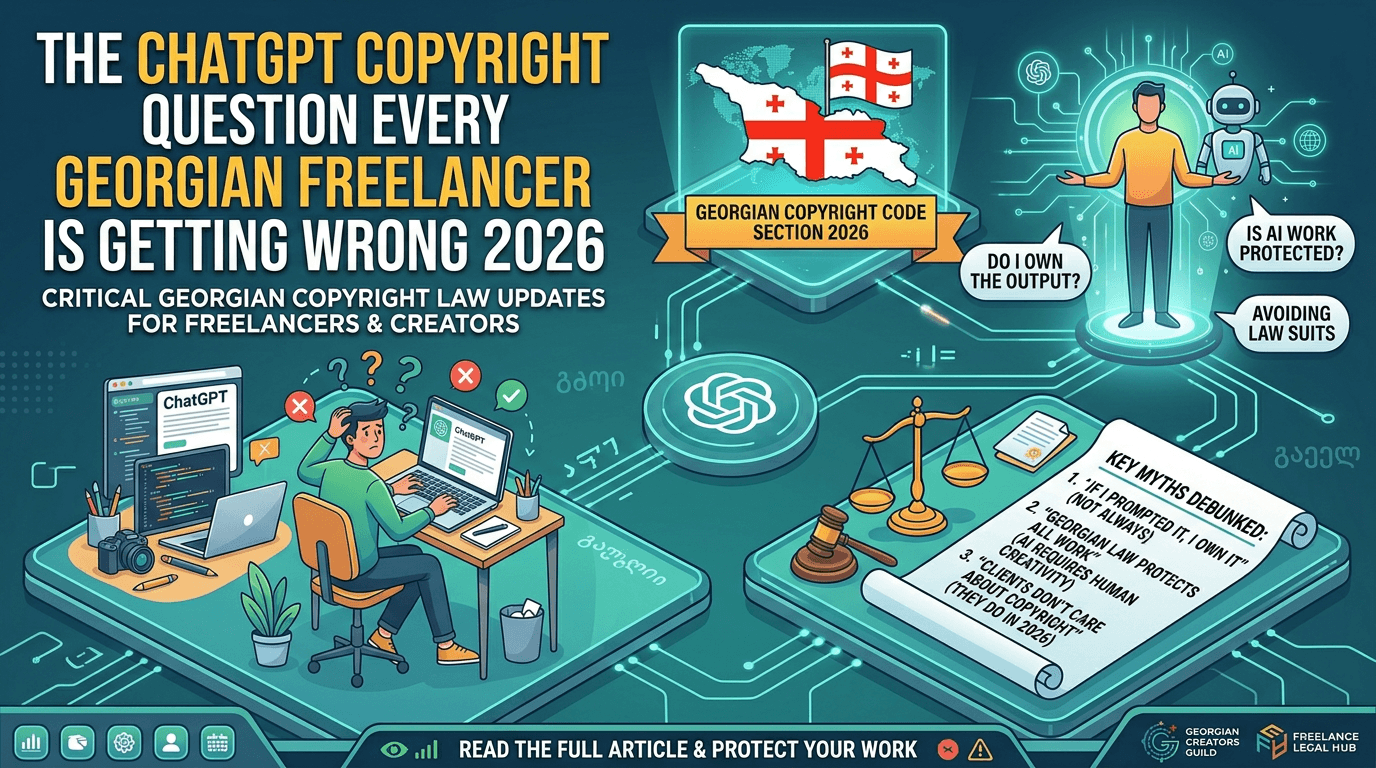
The ChatGPT Copyright Question Every Georgian Freelancer Is Getting Wrong 2026

The ChatGPT Copyright Question Every Georgian Freelancer Is Getting Wrong 2026

1. Can AI like ChatGPT be considered the author of a work under Georgian law?

No, according to Georgia's Law on Copyright and Related Rights, copyright belongs only to a natural person (human) whose intellectual-creative activity created the work. AI systems cannot be authors, so AI-generated content lacks automatic copyright protection afforded to human works.

2. Who owns the output generated by ChatGPT, and can I use it commercially?

Per OpenAI's Terms of Use, the generated output belongs to the user (with reservations, like OpenAI's right to use inputs for model improvement). Commercial use is allowed if you comply with platform rules, but legal risks like plagiarism or lack of originality may still apply.

3. What are the key legal risks when using AI-generated content?

Main risks include lack of originality leading to plagiarism or copyright infringement (if based on protected works), potential authorship disputes from clients, and evolving international practices (e.g., US Copyright Office requires significant human contribution for protection). Each work needs individual analysis.

The Nature and Intersection of Digital and Smart Contracts

The Nature and Intersection of Digital and Smart Contracts

Digital contracts and smart contracts intersect across the following dimensions: Taxonomic Classification: A smart contract is categorized as a subset of an electronic contract. It functions similarly to a traditional agreement, though executed in a comprehensively digitized format. Legal Nature: Smart contracts, analogous to other digital contracts, are encompassed within the legal definition of an electronic document. For a smart contract to constitute a legally binding agreement, it must fulfill the fundamental prerequisites of contract formation and validity (e.g., mutual consent of the parties and adequate terms)—requirements that programming code alone cannot substitute. Functional Overlap: Within the processes of concluding and executing a digital contract, a smart contract may be implemented as a technological utility (for example, as an automated payment mechanism for recurring transactions).