Artificial Intelligence and Copyright: Where is the Line Between Creativity and Algorithm?
In the past few years, generative AI systems, ChatGPT, Midjourney, Stable Diffusion, Suno and similar tools, have been able to create text, images, music or software code in a matter of seconds that are visually and substantively comparable to human creations. Behind this ability is the enormous amount of data on which these systems learn. Among them, millions of copyrighted texts, photographs, literary and musical works, most of which are used without the author's consent. This phenomenon raises two related, but separate, questions for copyright law: can a work created by artificial intelligence be protected by copyright and, if so, who is considered its author? And second, does training a model that uses protected works as training material without the author's permission violate copyright? Over the past two years, many questions have been raised regarding this issue, but there is still no definitive, uniform answer. For Georgia, too, this issue is vague and inexhaustible, because the Georgian Law “On Copyright and Related Rights” was created at a time when the existence of artificial intelligence was not even on the agenda.
The question of authorship: Can a machine be an “author”?
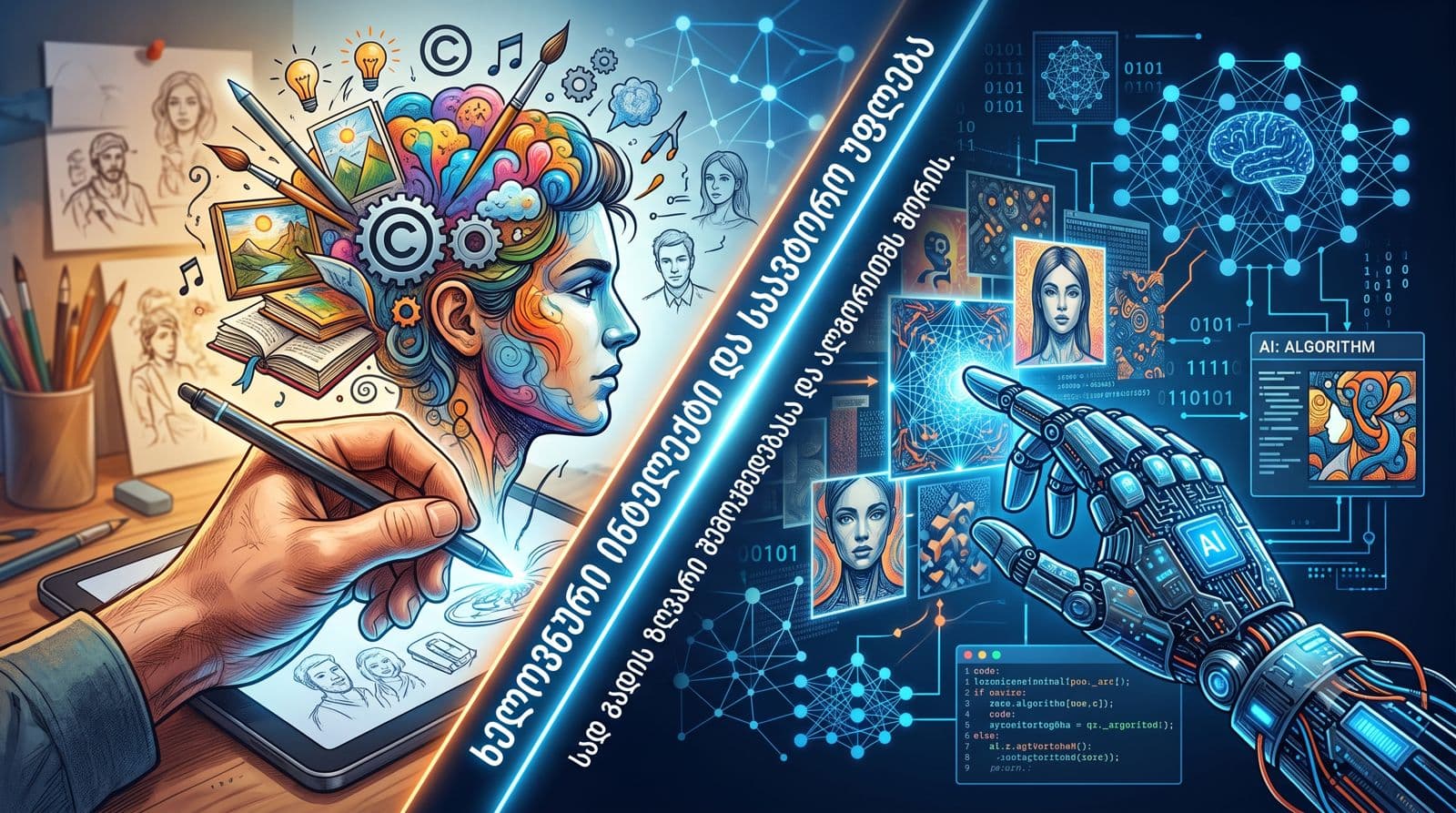
The basis of copyright law has historically been based on human intellectual and creative activity. The Berne Convention, which is the cornerstone of international copyright law, does not directly define the term “author”, however, the requirement of human authorship is so fundamental to the international copyright system that without it copyright would lose its “soul”. Copyright law is anthropocentric, according to which man is the main figure of creativity. Man is someone who can create a work with his intellectual mind.
This principle was put to the test in Thaler v. Perlmutter, where computer scientist Steven Thaler sought to register a copyright for a drawing created by his artificial intelligence system, the Creativity Machine, by attributing the authorship to the system itself. The U.S. Copyright Office rejected the application, and the Court of Appeals for the District of Columbia Circuit affirmed on March 18, 2025, that human authorship is a cornerstone of the copyright act and that an artificial intelligence system cannot be considered an author in itself. On March 2, 2026, the U.S. Supreme Court declined to hear the case, ultimately upholding the ruling. It is important to note that this does not mean that any work created with the help of artificial intelligence is beyond protection; the rule only requires that the author of the work be the human who used the artificial intelligence as a tool, not the machine itself.
The US Copyright Office's January 29, 2025 report, "Copyright and Artificial Intelligence, Part 2: Copyrightability," also points in the same direction, stating that a product generated by artificial intelligence will be protected by copyright only if a person has identified sufficient creative elements. According to the Copyright Office, even a very detailed and complex prompt does not grant the author ownership of the generated product, because the instruction is by its very nature an instruction, not a creative expression. In contrast, if a person creatively selects, arranges, or modifies the material created by artificial intelligence, such a result may be protected in the part where human creative contribution is revealed. This part requires considerable caution, because not all products created with the help of artificial intelligence can prove the element of creativity, because only mechanical application is not a process where human vision and thought are visible.
A similar principle is also embedded in Georgian legislation, although without a direct connection to artificial intelligence. According to subparagraph “a” of Article 4 of the Law of Georgia “On Copyright and Related Rights”, an “author” is a natural person whose intellectual and creative activity resulted in the creation of a work. This definition follows the same logic as US and international practice, where authorship requires intellectual and creative activity, which a machine does not possess. However, in Georgia, there is currently neither judicial practice nor an official explanation from Sakpatenti on how the issue of authorship of a work created with the help of artificial intelligence should be assessed in specific cases. Especially in cases where copyright is not subject to registration and the person who creates the work is considered the author immediately upon creation.
Training data: the development or disruption of artificial intelligence?
No less acute than the issue of authorship is the second problem: whether it is legal to use copyrighted works to train artificial intelligence models without the author's permission and consent.
The most high-profile intellectual property infringement lawsuit in the generative AI development stage involves The New York Times’ lawsuit against OpenAI and Microsoft. According to the lawsuit, filed in December 2023, the defendant companies used millions of the newspaper’s articles to train the ChatGPT model without proper authorization. On April 4, 2025, the U.S. District Court for the Southern District of New York issued an interim order partially granting the defendants’ motion to dismiss the case, but leaving the claims of principal, direct, and accessory copyright infringement in place for the merits. The case is currently in the discovery and exchange of evidence stage, and no final precedent has been set yet. Similar legal issues are at play in Getty Images v. Stability AI, where the subject of the dispute is the unauthorized training of artificial intelligence models and the use of visual works without consent. In this context, in addition to unauthorized exploitation, the main challenge is the fundamental dilemma of interests: on the one hand, the processing of mass data is a technological necessity for the evolution of artificial intelligence, the refinement of its algorithms, and the offering of highly qualified products to users; on the other hand, this innovative process must be carried out within the framework of legality, with full respect for the will of the creators of the original content and their property and non-property rights.
The EU approach: transparency as a compromise
The European Union, unlike the US and the UK, where the legal landscape is largely shaped by judicial precedents, has chosen to address this issue directly at the legislative level. Article 53 of the EU Artificial Intelligence Act imposes two fundamental obligations on providers of general-purpose AI models.
First, develop and implement policies to ensure compliance with EU copyright law, in particular to respect the exclusive right of rightholders to opt out of the text and data mining exception, under which the author should have the right to refuse, which is his fundamental right.
Conclusion: What Georgian creators and businesses should know
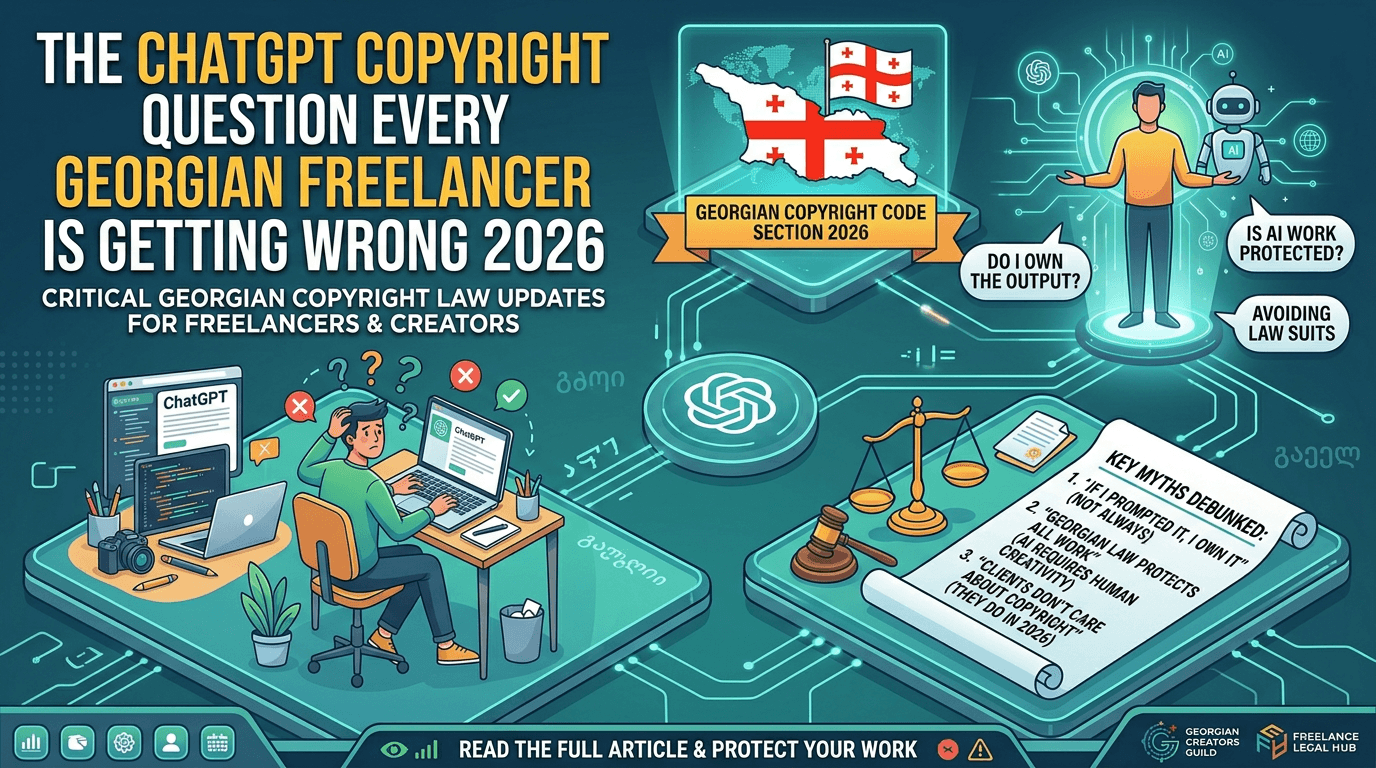
Several practical conclusions can be drawn from existing international practice. First, a text, image, or music generated solely by artificial intelligence, without substantial human creative input, cannot benefit from copyright protection, neither in Georgia nor in international jurisdiction. This conclusion follows from the data of 2026. Accordingly, in the future, it is possible for artificial intelligence to develop to such an extent that it becomes possible to assign authorship to it, but as of 2026, artificial intelligence cannot be an author.
Based on the theoretical and practical analysis developed in the paper, it is appropriate to highlight several fundamental recommendations:
First, for creators who use artificial intelligence as a supporting tool, it is necessary to pre-record and preserve materials confirming their creative contribution. This involves procedural documentation, which includes textual instructions (prompts), subsequent editing of the work, selection of components and compositional decisions. In the future, in the event of a potential legal dispute, this evidence will help the creator objectively substantiate the presumption of originality and authorship.
Second, businesses that integrate AI models or directly develop them must strictly control their databases. They must ensure that there is a legal basis (license or permission) for lawful access to the materials used to train the algorithms. This control is particularly critical when interacting with the European market, where the strict transparency obligations imposed by the AI Act are already mandatory.
Third, it is necessary to closely monitor the dynamics of the development of Georgian legislation, which necessitates the introduction of legislative amendments.