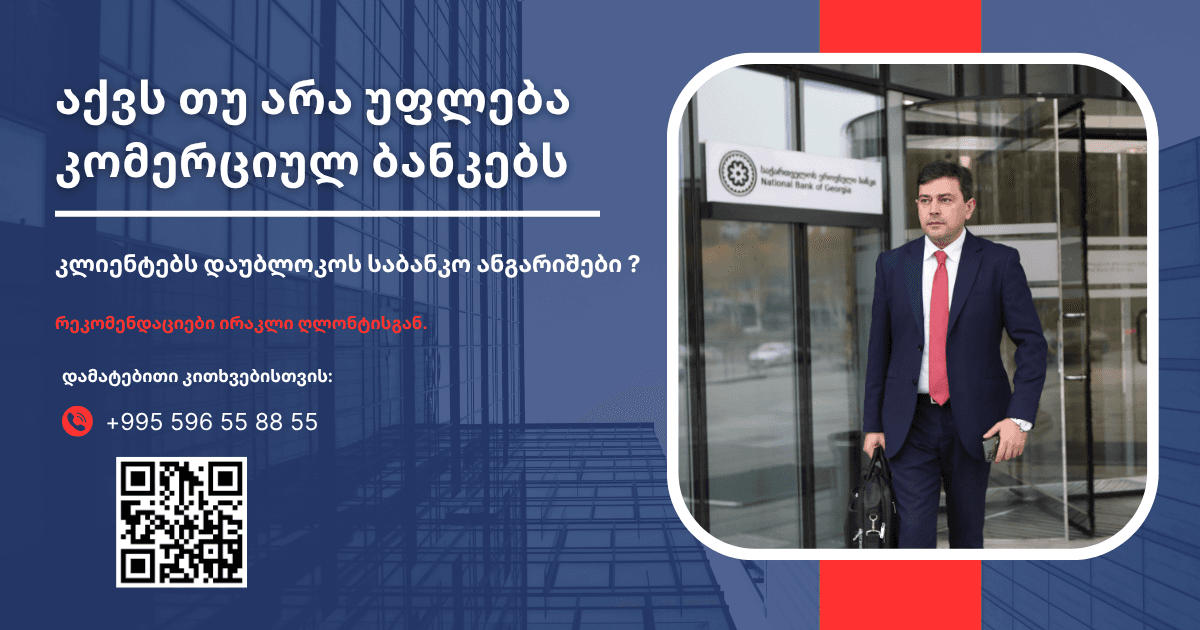
The Georgian legislation regulates the procedure for opening and closing bank accounts in detail and exhaustively. Nevertheless, in practice, there are still cases when commercial banks go beyond the requirements of the current legislation and decide on the issue of closing bank accounts on incorrect legal grounds.
The procedure for closing a valid bank account is determined by the Law of Georgia “On the Activities of Commercial Banks” . According to Article 21, Paragraph 5 of the aforementioned Law, the bank is authorized to close the account of the client if the client refuses to provide information or documentation required by law. This refers to data and information, the basis for the request of which is derived from both Georgian legislation and international agreements concluded between Georgia and the United States of America and relevant international obligations.
Accordingly, when the client fully cooperates with the bank, fills out the relevant questionnaires in good faith, submits the requested documentation, and additionally expresses his willingness to provide the bank with the necessary information at any time, there is clearly no legal basis for closing the account.
In practice, there are frequent cases when commercial banks interfere with the legal mechanisms of refusing to open an account and closing an already active account. In particular, Article 21, paragraph 4 of the Law of Georgia “On the Activities of Commercial Banks” does indeed grant the bank the right to refuse to open an account without justification. However, this norm does not apply to already opened and active bank accounts, the issue of closing which is the subject of independent legal regulation.
In addition, the Instruction on Opening Accounts in Banking Institutions was approved by the Order No. 24/04 of the President of the National Bank of Georgia dated April 7, 2011. Paragraph 3 of Article 12 of the said Instruction determines the cases when a bank account may be closed, which once again confirms that the said issue is clearly and in detail regulated.
However, in practice, banks often refer only to “internal bank policy” or “internal bank standards” and justify the decision to close an account on this basis. Such an explanation cannot in itself be considered a sufficient legal basis, since an internal document of a private organization cannot change or expand the rules and principles established by law.
The fundamental principle of the rule of law is that any right should be exercised in accordance with its purpose, in good faith and fairly. Otherwise, there will be an abuse of the right. When the decision to close an account is based only on a vague and unspecific reference to meaningless “domestic policy”, without a proper study of the relevant factual circumstances and legal justification, it is logical that a well-founded suspicion arises that we are dealing with an unfair use of the right.
If we assume that a bank can close active accounts only on the basis of its own “internal policy”, this will practically create a situation where a private entity determines the scope of its own authority, ignores the interests of the customer, avoids assessing individual circumstances and is effectively exempt from the restrictions established by law. Such an approach is incompatible with both the principles of a legal state, the stability of civil turnover and the requirements of legal certainty.
In addition, standard contractual terms and conditions established on the basis of the “internal policy of the bank” require assessment in the light of Article 346 of the Civil Code of Georgia. According to this norm, a standard contractual term is invalid if it substantially harms the other party to the contract, contrary to the principles of good faith and trust. Vague and broad discretionary wording creates a real risk of unfair use and therefore requires special legal control.
Judicial practice confirms that in many cases on this issue, the court has given priority to the principles of the rule of law, legal certainty, and protection of consumer rights. It is precisely as a result of such an approach that it became possible to effectively protect the rights of those clients whose decisions taken by commercial banks did not comply with the requirements of applicable legislation.
Of particular note is the professionalism and principledness of those judges who were guided by the principle of the rule of law in such cases and contributed to the formation of fair judicial practice, including the judges of the Tbilisi City Court, Ms. Tamar Lakerbaia and Ms. Eliso Tukvadze.
Lawyer Irakli Ghlonti